How to Build a Minimalist Jewelry Capsule You’ll Actually Wear
Mostly gold, sometimes silver, and built around the pieces that actually leave the house. A practical approach to a smaller, more personal jewelry collection.
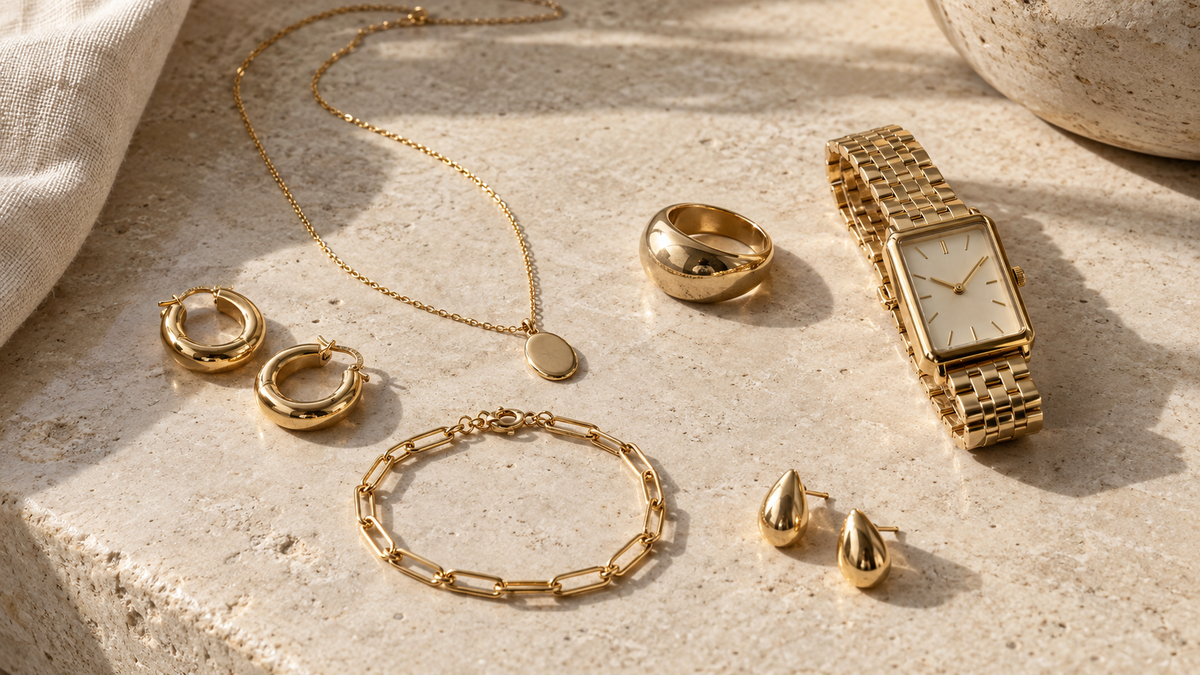
My everyday jewelry is a fairly short list: earrings, a bracelet, a watch, and a pendant. Mostly gold, sometimes silver. The other pieces tend to wait for a big occasion.
Writing that down makes my taste sound very organized. In reality, it simply tells me where to start. If those are the things I reach for, they deserve more attention than a ring stack I would rarely wear, however lovely it looks in someone else’s photograph.
That’s the version of a minimalist jewelry capsule I’m interested in. A small collection that makes getting dressed easier, with enough personality that it still feels like yours.
You can build one around five or six pieces, counting a pair of earrings as one. You can also begin with the three things you already wear. The useful part is choosing jewelry that works with your clothes and your routine, then adding slowly when something is genuinely missing.
Here’s how I’d approach it, including a few shopping examples for different budgets. The starting point is your jewelry box.
Start with the pieces that already leave the house
Before making a wishlist, wear your existing jewelry for a week and pay attention to what happens. Which earrings go on without much thought? Which necklace gets taken off because the pendant catches on your top? Does your bracelet stay on through the workday, or end up beside your keyboard?
Those little annoyances are worth taking seriously. A clasp you struggle with every morning is a reason to choose differently next time. So is an earring that feels fine for ten minutes but distracting by lunch.
Put your repeat pieces together in a small tray. Keep the occasion jewelry somewhere separate for now. This is an observation exercise; there’s no need to get rid of anything.

The tray will probably tell you more than a long list of supposed essentials. If it contains studs, two rings, and no necklaces, build around that. My own everyday categories are different, and I’d be doing myself no favors by borrowing somebody else’s routine wholesale.
A minimalist jewelry capsule is a small, versatile selection you can combine across your usual outfits. Its size should follow your habits. There is no prize for reaching a particular number.
Give your earrings the most attention
Earrings would be my first decision because they’re already part of what I wear regularly. They also sit close to your face, where a small change in shape can make a familiar outfit feel different.
For an everyday pair, I’d look at small hoops, huggies, or simple studs. The choice depends on what you enjoy wearing. Huggies suit someone who likes a close fit; small hoops leave a little more space around the lobe. A tiny stud can be enough if you prefer your necklace to do the talking.

Look beyond the front-facing product photograph. Check the dimensions, closure, and whether the listing is for a pair or a single earring. Then look at an on-ear photograph for scale. “Small” is surprisingly unhelpful without a measurement.
For an accessible starting point, Madewell’s Chunky Huggie Hoop Earrings were listed at $35 in warm gold when checked. The 16 mm design has a slightly geometric shape, and the materials are plated brass and cubic zirconia. I like the idea of that little bit of shape against a plain T-shirt or shirt collar. These are fashion jewelry, so buy them with expectations appropriate to a plated finish.
Madewell’s indexed customer-review summary also flagged checking that the clasp closes securely. That’s a useful thing to test on arrival, rather than something I can judge from a photograph.
I would start with one everyday pair and wear it before buying three near-duplicates. Once you know what feels comfortable, a second pair can offer a different mood.
Choose a pendant around your necklines
A pendant is already in my regular rotation, so it earns a place here without much persuasion. But the chain length needs as much thought as the pendant itself.
Consider the tops you wear most often. An open shirt leaves room for a shorter necklace to sit against the skin. A crewneck might work better with a pendant that falls clearly below the collar. With a high neckline, a longer chain can be more visible than something that disappears beneath the fabric.
Before ordering, use a piece of string to compare the listed length against two or three of those tops. It’s an unglamorous little exercise that can save you buying the right pendant on the wrong chain.
For a personal detail, I like the direction of an initial, a small locket, or a pendant you already associate with someone. It doesn’t have to be completely plain to belong in a minimalist collection.
Mejuri’s Bold Letter Pendant Necklace is one example: an accordion-textured initial in 18k gold vermeil, supplied with a 20–22-inch chain. The selected H version was $84 on final sale when checked. That longer length and the final-sale restriction matter more to the decision than the discount. Check your chosen letter’s availability and terms before ordering.
If you already have a pendant you love, I’d put the shopping energy into learning how it works with your clothes. Try it with the shirt partly open, over a simple knit, or alone with small earrings. There may be more range there than you think.
Let the watch count
I wear a watch, so leaving it out of the capsule would make the whole exercise feel slightly detached from real life.
A watch occupies visual space on your wrist. Its case, strap, and size affect what you want beside it. A substantial metal bracelet watch might give you all the wrist detail you need. A petite gold-tone bracelet watch can give you that same polished finish in a smaller proportion. Try a fine bracelet on the other wrist if you enjoy wearing both.
The Timex Cavatina Mini 17 mm Stainless Steel Expansion Band Watch shows the kind of proportion I mean. This gold-tone version has a small cushion-shaped case and a matching metal expansion band. At $139 when checked, it’s a considered purchase rather than a capsule necessity. The page showed preorder and availability-notification options, so check delivery availability before planning around it. Gold-tone describes the finish here; this is not a gold jewelry purchase.
If your current watch is silver, keep it. I mostly wear gold, but I also wear silver sometimes, and I wouldn’t replace a useful watch just to make every metal match.
For the bracelet, think about how it feels during the things you actually do. A close-fitting chain and a loose bangle behave differently when typing, carrying bags, or pulling on a sweater. Wear the watch and bracelet on opposite wrists if that feels better or keeps them from rubbing together.
A more expensive option is Quince’s 14K Gold Paperclip Chain Bracelet, listed at $258 for the 3.5 mm link version. It has a lobster clasp and a clean, open-link shape. I’d consider that an upgrade for someone who already knows she wears bracelets frequently. Keeping your existing bracelet is a perfectly good starting point.

Make room for one ring
I don’t reach for rings as often as earrings or a pendant, but one thoughtfully chosen ring belongs in this conversation. It gives you another way to change an outfit without adding a whole new set of accessories.
I’d start with a smooth band or a modest dome shape. A rounded surface has a little presence on its own, so you don’t need to build a stack around it. If you already wear a wedding band, a sentimental ring, or another favorite, that can fill the space. There’s no need to buy a second version of something that already works.
Mejuri’s Thin Dôme Ring in 18k gold vermeil is a useful example, listed at $138 when checked. Its top is 6.2 mm wide, tapering to a 2 mm shank. I like that balance for this capsule: enough shape to notice, without needing several rings beside it. The material is gold over sterling silver, so factor the plated finish into your expectations.
Check the sizing guide and return terms before ordering. Once it arrives, try making a fist, holding your phone, and carrying your usual bag. A ring that presses into neighboring fingers will probably spend more time in its box than on your hand.
For me, this would be an optional addition for days when I want something extra. For someone who wears rings constantly, it might be the first piece in the capsule.
Leave room for the piece with personality
This is the part I care about: a capsule can include something noticeable.
If all your choices are tiny, plain, and similar, you may end up with a collection that is easy to coordinate but doesn’t give you much pleasure. One sculptural earring, textured pendant, or colorful stone can make the familiar pieces feel more personal.
I’d choose that detail within a category I already wear. Since earrings are part of my everyday routine, an expressive second pair makes more sense for me than several statement rings saved for rare occasions.
Try one pair with a little curve or volume. Wear it with your usual bracelet and watch, then decide whether the pendant adds anything. Sometimes the neckline looks better left clear.
A brooch could fill this role too, if you love wearing one. Our guide to styling a brooch has ideas for taking it beyond the obvious lapel placement. The test is whether you can picture using it with clothes you own.
Your special-occasion jewelry can stay special. It doesn’t need to justify itself by becoming appropriate for a Tuesday morning.
Mostly gold still leaves room for silver
Using gold as the main metal makes sense for me because it’s what I choose most often. That gives the collection a consistent starting point without turning silver into a problem.
If mixing feels awkward, keep something else consistent: similar scale, simple shapes, or a recurring finish. Small gold earrings and a slim silver watch are easier to read together than several pieces all competing for attention in different ways.
You can repeat the second metal if you like the effect, but you don’t need to buy a two-tone piece to give yourself permission. Start with what you have and look at the whole outfit in daylight.
Also pay attention to the shades within “gold.” A pale finish and a very yellow finish can look quite different together. Product images vary with lighting, so compare pieces in person during the return window whenever possible.
Spend according to wear, and read the material description
My spending order would follow frequency: the earrings and pendant first, then any wrist piece that needs replacing. A trend experiment can have a smaller budget. An everyday favorite might deserve a more considered upgrade.
The material description helps explain what you’re paying for. Gold vermeil is gold plating over sterling silver. Other gold-plated jewelry may use a different base metal. Gold-filled jewelry uses a mechanically applied gold layer. A karat mark, such as 14K, describes gold content; it doesn’t tell you everything about construction, weight, or comfort. The FTC’s jewelry-buying guide explains the terminology and notes that plating eventually wears away.
That doesn’t make an affordable plated piece a bad purchase. It makes care instructions and realistic expectations part of the purchase.
For a starter budget, I’d rather leave a category empty than fill it with something I already feel doubtful about. If you have $100 available, you could buy the $35 earrings and keep the remainder for a later decision. You don’t need to assemble the entire collection in one order.
Read reviews for practical patterns: closure problems, unexpected size, uncomfortable weight, or finish changes after wear. A high average rating is less useful if the recurring complaint happens to be the thing that bothers you most.
Try the collection with three actual outfits
Before adding anything else, put the capsule through a small wardrobe test.
With a work outfit, try your everyday earrings, watch, and pendant. Check that the chain sits comfortably with the neckline and that the bracelet feels fine at your desk. You can leave it off if the watch already feels like enough.
With jeans and a T-shirt, try the same pendant and bracelet, then switch the earrings. This is where a slightly larger or more sculptural pair can earn its place. The clothes stay familiar while the jewelry changes the emphasis.
For dinner, try the dome ring with the expressive earrings and choose the necklace according to the neckline. You can bring back the everyday pendant if it works, or leave that area bare. If you need outfit ideas around those choices, our date-night outfit guide is a useful next stop.
Take a quick photograph of each combination for yourself. Look at the outfit as a whole rather than inspecting every item individually. If one piece never seems to work, give it another role or set it aside. That’s more useful information than buying something else to rescue it.
Keep the everyday pieces easy to find
The pieces you wear most should be easy to reach, with chains separated so you aren’t starting the morning by untangling them. Keep the rest protected according to the material and the maker’s instructions.
A little care still matters even with a more expensive purchase. Quince’s bracelet instructions, for example, advise avoiding harsh chemicals and abrasives, removing jewelry before physical activity, and storing it in its box or a soft cloth bag. Follow the guidance for each piece rather than assuming an everyday style is suitable for every activity.
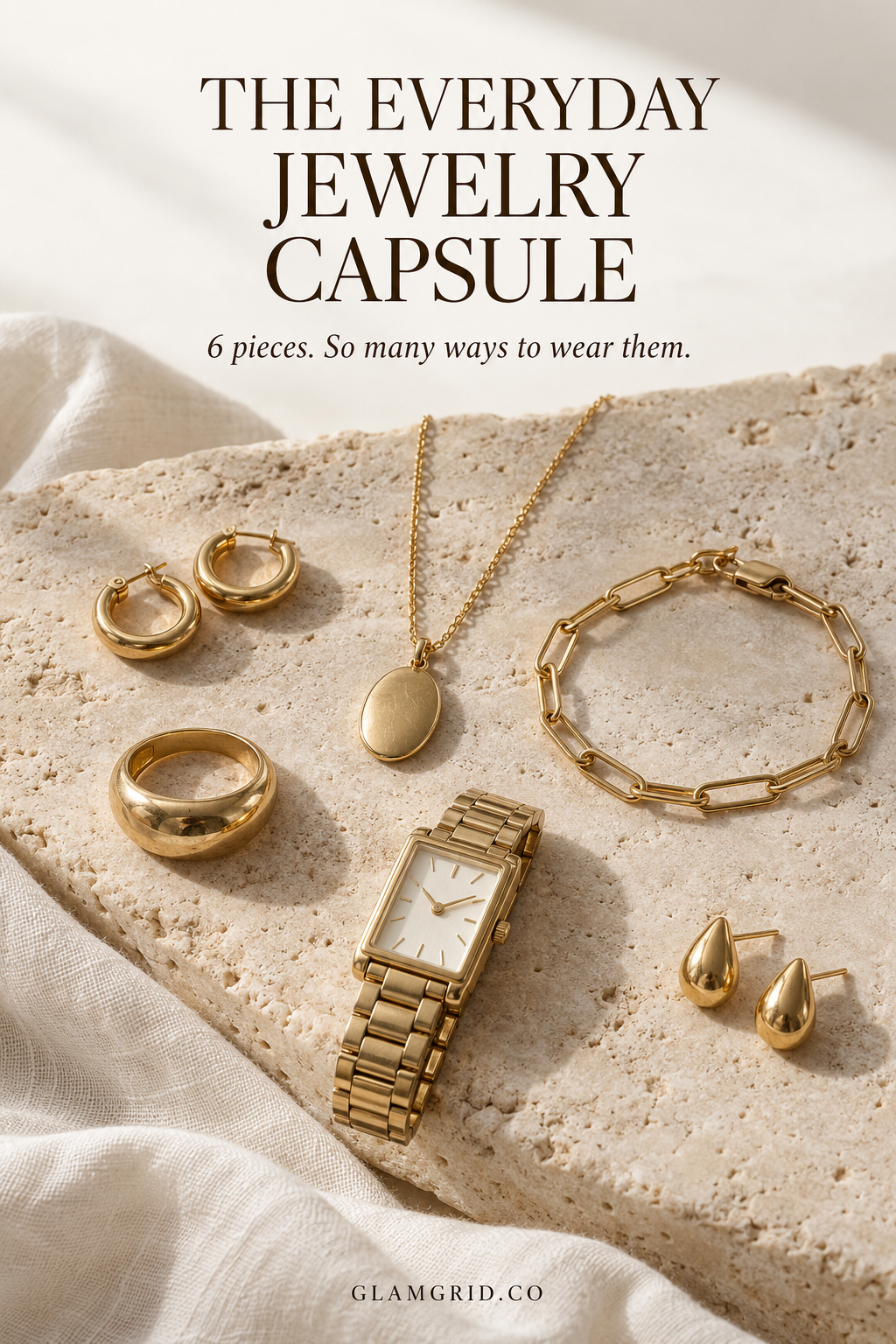
For my version of a minimalist jewelry capsule, the shape is simple: everyday earrings, a pendant, a bracelet, a watch, another pair of earrings with a bit more presence, and one simple ring for the days I want it. Silver can come in when I feel like it. Occasion pieces can wait for their occasions.
That leaves me with a useful question before buying anything new: where would this fit into the way I already get dressed?