14 Types of Embroidery You Need to Know
Discover 14 distinct types of embroidery, from cross-stitch and crewelwork to tambour, goldwork, Bargello, and more.
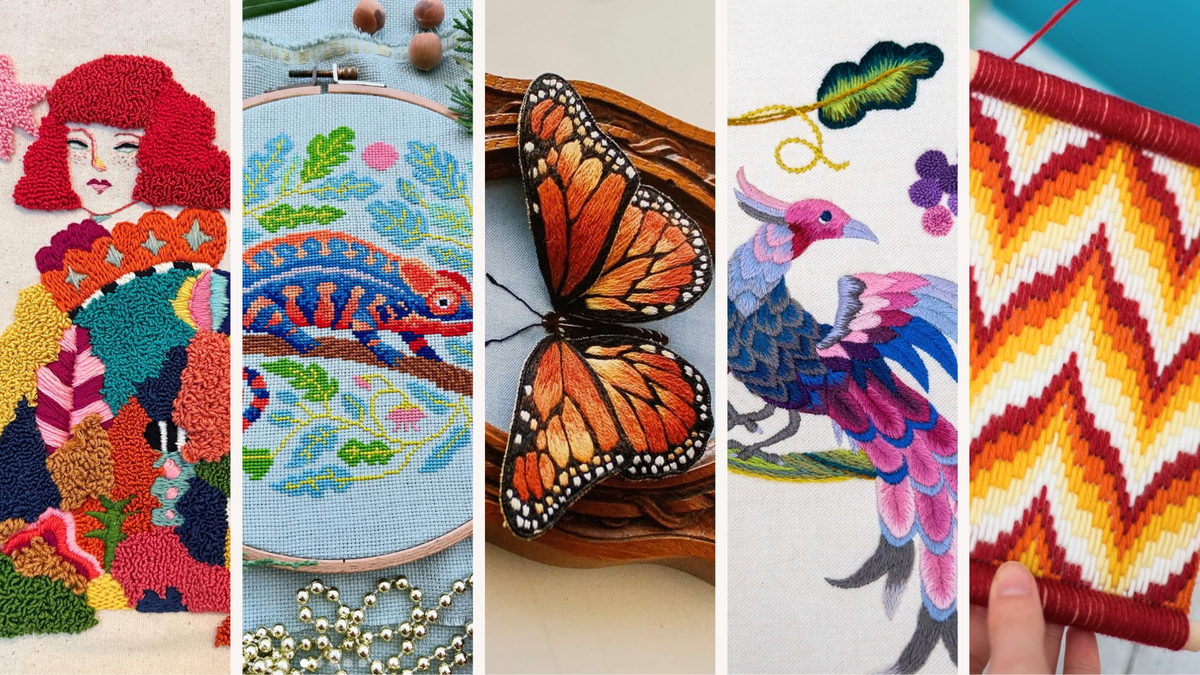
Embroidery has been used to decorate clothing and textiles for centuries, turning simple fabric into something highly personal and intricate. From delicate whitework and intricate counted stitches to raised flowers and shimmering metallic threads, here are 14 traditional embroidery styles and techniques worth knowing.
1. Cross-Stitch
Cross-stitch is one of the most recognizable forms of embroidery. It is made by placing two diagonal stitches over one another to create an X, usually following a counted grid on an evenly woven fabric.
The technique has been practiced throughout Europe and became particularly popular in domestic needlework. Traditional designs often feature flowers, geometric motifs, alphabets and folk imagery.
Today, cross-stitch remains popular for both decorative textiles and contemporary craft projects.
2. Punch Needle
Punch needle creates a looped, textured surface by repeatedly pushing a threaded needle through the fabric. Instead of forming individual surface stitches, the thread is pulled into loops, producing a soft, almost tufted appearance.
The technique has roots in European textile traditions and is particularly associated with Northern European and Scandinavian craft. Modern punch needle is often used to create wall art, cushions, rugs and other decorative textiles.
Its distinctive texture makes it quite different from flatter forms of embroidery.
3. Assisi Embroidery
Assisi embroidery is an Italian counted-thread tradition named after the town of Assisi.
Its most distinctive characteristic is the relationship between the embroidered motif and the background. Rather than filling the design itself, the embroiderer typically stitches the surrounding background, leaving the central motifs unworked.
Traditional designs often include stylized animals, birds, plants and geometric borders. The result is a striking negative-space effect that makes Assisi embroidery immediately recognizable.
4. Broderie Anglaise
Broderie anglaise, meaning “English embroidery,” is a form of whitework characterized by small cut-out areas, eyelets and decorative embroidered edges.
The technique became particularly associated with England during the 19th century and was widely used for delicate garments and household textiles.
Its airy appearance has made it a recurring feature in fashion, particularly in summer dresses, blouses, children's clothing and romantic, feminine garments.
5. Ribbon Embroidery
Instead of using ordinary embroidery thread, ribbon embroidery uses narrow ribbons to create dimensional flowers, leaves and other decorative motifs.
The ribbons can be folded, twisted, gathered or looped to create shapes that would be difficult to achieve with conventional thread. The result is a distinctly three-dimensional form of embroidery.
Floral designs are especially characteristic, making ribbon embroidery popular for clothing, accessories, home textiles and decorative pieces.
6. Tambour Embroidery
Tambour embroidery is worked using a small hook rather than a conventional embroidery needle. The hook creates a continuous chain stitch on the fabric, allowing intricate designs to be produced relatively quickly.
The technique became particularly associated with France and was widely used in European couture and luxury textiles.
Tambour embroidery is still important in haute couture, where artisans use it to apply delicate threadwork, beads, sequins and other embellishments to garments.
7. Stumpwork
Stumpwork is a form of raised embroidery that creates a distinctly three-dimensional effect. Padding, layered fabric and additional stitched elements are used to make flowers, leaves, insects and other motifs appear to rise from the surface.
The technique became particularly popular in England during the 17th century. Elaborate stumpwork pieces could depict entire miniature scenes populated with flowers, insects, animals and figures.
Unlike conventional flat embroidery, stumpwork treats the textile almost like a miniature sculpture.
8. Ayrshire Embroidery
Ayrshire embroidery is a delicate form of Scottish whitework that developed in the 19th century in Ayrshire, Scotland.
It is characterized by fine white threadwork, intricate floral motifs, tiny eyelets and areas of openwork. The embroidery was particularly suited to lightweight fabrics and was used extensively for fashionable clothing and accessories.
Its refined, almost lace-like appearance made it especially popular for collars, cuffs, children's clothing and women's garments.
9. Crewelwork
Crewelwork is a type of surface embroidery traditionally worked with wool rather than cotton or silk thread. The technique is strongly associated with England and has a long history in British decorative textiles.
One of its most recognizable forms is Jacobean embroidery, featuring elaborate stylized flowers, leaves, vines, birds and fantastical plants.
The use of wool gives crewelwork a slightly heavier and more textured appearance than many forms of fine embroidery.
10. Hardanger Embroidery
Hardanger embroidery originated in the Hardanger region of Norway and combines counted-thread embroidery with cutwork.
The fabric is carefully stitched and sections are then cut away to create geometric openwork designs. The embroidery is traditionally worked in white thread on white fabric, giving it a crisp, lace-like appearance.
Hardanger has traditionally been used for household linens, clothing and decorative textiles and remains an important Norwegian needlework tradition.
11. Blackwork
Blackwork is a form of counted and surface embroidery traditionally worked primarily with black thread on a light-colored fabric.
It is particularly associated with England, where it became fashionable during the Tudor period. Early examples often featured elaborate scrolling and botanical patterns, while later blackwork developed increasingly geometric designs.
The strong contrast between black thread and white fabric gives it a graphic quality that still makes it appealing to contemporary designers.
12. Goldwork
Goldwork is an elaborate form of embroidery that uses metallic threads to create shimmering, highly decorative surfaces.
Historically, goldwork was associated with wealth and status and was used extensively for ecclesiastical vestments, royal garments, military uniforms and other ceremonial textiles across Europe.
Traditional goldwork can involve several types of metallic thread, padding and specialized techniques to create raised and reflective surfaces. It remains particularly important in couture and ceremonial dress.
13. Mountmellick Embroidery
Mountmellick embroidery is a distinctive Irish form of whitework that originated in the town of Mountmellick in County Laois during the 19th century.
Unlike delicate whitework styles such as Ayrshire embroidery, Mountmellick is known for its heavily textured, raised stitches. Floral and botanical motifs are especially common.
The monochromatic palette combined with substantial texture gives Mountmellick embroidery a tactile, almost sculptural appearance.
14. Bargello
Bargello, also known as Florentine embroidery, is a counted-thread technique traditionally associated with Florence, Italy.
It is characterized by vertical stitches arranged into geometric patterns, often creating distinctive waves, zigzags, flames and repeating motifs.
The technique was historically used on decorative textiles and furnishings. Its bold geometric patterns have also experienced several revivals in modern interior design and craft.
These traditions demonstrate just how many different possibilities exist within embroidery. A simple needle and thread can produce delicate lace-like surfaces, bold geometric patterns, raised flowers, textured loops or glittering metallic designs.